Start with the exhaust job, not the canopy shape
A Type I hood is used over commercial cooking that produces grease or smoke. A Type II hood is used for heat or moisture from equipment that does not produce grease or smoke under the cited 2021 International Mechanical Code distinction. That difference changes whether a grease-exhaust cleaning call is the right conversation.
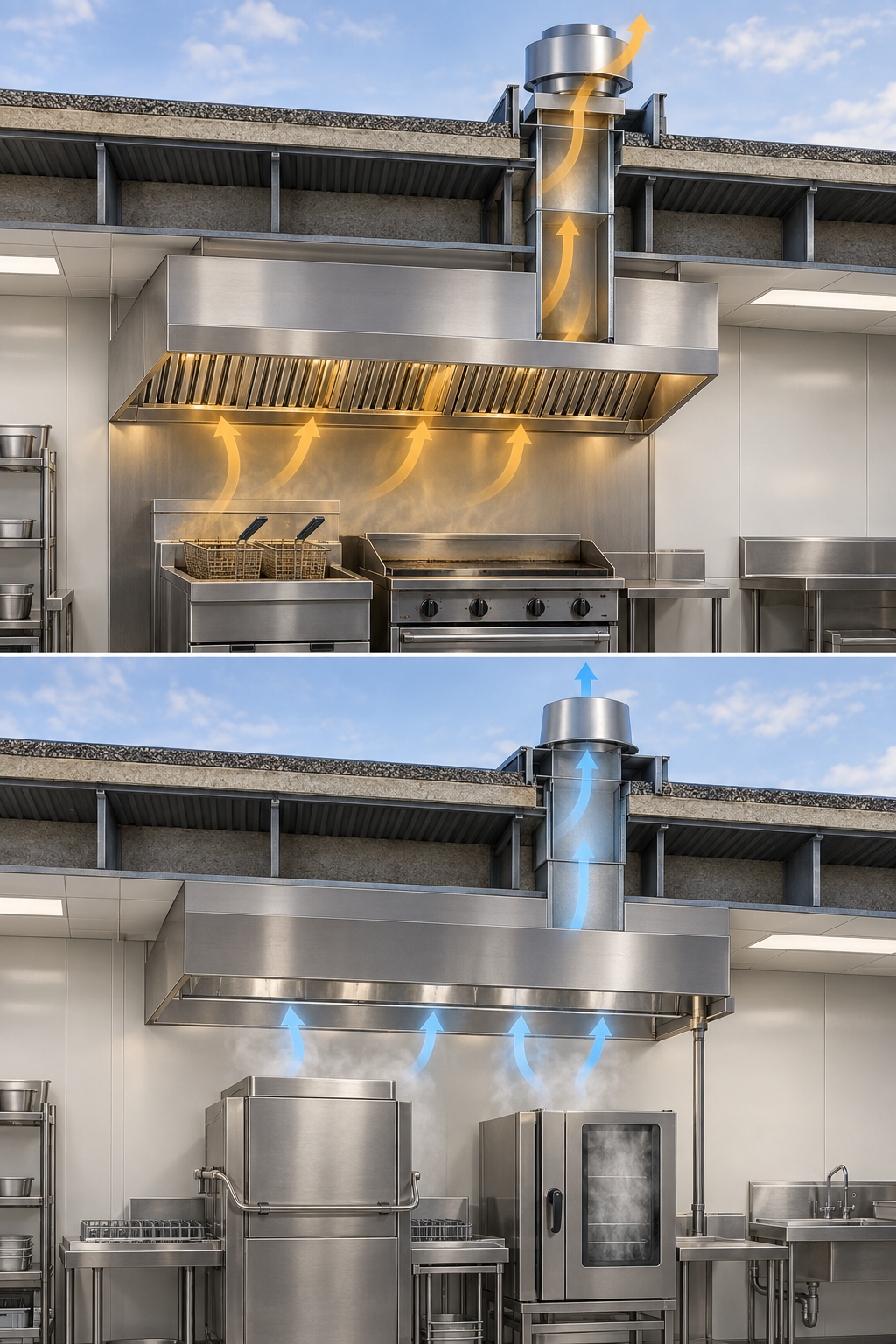
Do not decide the hood type from a wide canopy, a shiny surface, one appliance name, or this illustration. Start with safe-to-read labels, the appliance list, the connected duct and fan, approved plans or manuals, and the current direction from the responsible authority. If those sources disagree or are missing, record the uncertainty instead of guessing.
The commercial hood-cleaning page owns the complete grease-path scope and phone next step. This guide helps you decide whether that is the path you are actually discussing.
Compare the two paths
| Planning question | Type I grease hood | Type II heat or condensate hood | What the manager should do |
|---|---|---|---|
| What is it intended to capture? | Grease or smoke produced by commercial cooking. | Heat or moisture without grease or smoke. | List the actual appliances and cooking processes under this exact hood. |
| What path matters? | Hood, grease-removal devices, grease duct, exhaust equipment, and related accessible areas. | Hood, condensate or heat path, metallic duct, termination, and manufacturer-defined components. | Match the canopy to its own duct and fan or termination; do not combine two systems in one photo set. |
| Which cleaning call fits? | A commercial grease-exhaust cleaning call may fit when the system has grease deposits or is due for its established inspection/cleaning plan. | A grease-exhaust cleaning call may be the wrong lane; ask what manufacturer maintenance or non-grease exhaust service applies. | Name the hood type only when supported, then describe the observed condition and requested scope. |
| What should not be inferred? | A Type I label does not prove current cleanliness, complete access, compliance, or a specific schedule. | A Type II label does not mean “maintenance free,” and appearance does not prove that no grease-producing process is connected. | Keep cleaning, maintenance, repair, suppression, design, and approval records separate. |
If several appliances sit under one hood, do not evaluate them one at a time and ignore the shared canopy. The cited 2021 IMC says that when any appliance under one hood requires Type I, a Type I hood is required. That is a general code rule, not a remote approval of your cookline.
Build a hood identity card
Create one record for each hood. A restaurant with two canopies may have two different exhaust paths, service histories, and open questions.
| Record this | Where to look safely | Why it changes the call | Do not assume |
|---|---|---|---|
| Exact location | Kitchen name, cookline position, or a simple manager-assigned system ID. | Keeps photos, estimates, and reports attached to the correct hood. | “The main hood” means the same thing to every person. |
| Label, manufacturer, and model | Safe-to-read equipment label, manual, submittal, or approved plan. | Provides stronger evidence than appearance and may identify the intended application. | A missing or unreadable label can be replaced with a guess. |
| Appliances and process | Manager inventory of what actually operates under the canopy. | Shows whether the conversation involves grease/smoke or heat/moisture. | Fuel type or one appliance name settles the complete code question. |
| Filters, gutter, or condensate features | Ground-level view without removing protected parts or opening equipment. | Helps a qualified party match the visible hood to its documentation. | Filters alone prove Type I, or a clean gutter proves Type II. |
| Connected duct and fan | Plans, prior reports, safe interior view, and safe ground-level roofline photos. | Defines which exhaust path belongs in the cleaning or maintenance scope. | Every canopy reaches the nearest visible rooftop fan. |
| Last supported service | Dated report, matched photos, invoice, label, and exception notes. | Separates proven work from a date remembered by staff. | A sticker proves every connected area was inspected or cleaned. |
| Open authority or repair item | Inspection note, plan comment, repair diagnosis, or written property request. | Keeps cleaning from being offered as the answer to a different problem. | Payment for cleaning closes another party's note. |
Photograph the complete hood face and its surroundings before taking close-ups. A close photo of one filter or label is difficult to match to the right system later. Do not climb, open electrical equipment, disturb suppression components, remove duct access panels, or move appliances just to complete the card.
Trace which components belong together
Start at Hood A and follow only records and safe visual evidence that belong to Hood A:
- Name the appliances and cooking process below it.
- Record the canopy identifier and safe-to-read label or manual.
- Count and photograph the visible filter bank or condensate features.
- Use plans, prior service photos, or a qualified party to identify the connected duct.
- Match that duct to its exhaust fan or termination.
- Attach the last report, photos, invoice, and exception notes to the same system ID.
Repeat the sequence for Hood B instead of sending one mixed photo folder. If the path cannot be confirmed, say which link is unknown. A focused call can ask someone to verify the connection; it should not hide the gap.
The site’s hood-versus-exhaust page explains why “hood cleaning” and “kitchen exhaust cleaning” may refer to the same grease-removal job. The scope still needs to name the actual connected components.
Route the question to the right lane
| Question or condition | Conversation to start | Record to keep |
|---|---|---|
| Grease deposits in a Type I hood, filters, accessible duct, fan, or related path | Commercial hood and grease-exhaust cleaning. | System-specific scope, dated report, matched photos, invoice or work order, label details, and access exceptions. |
| Steam, condensate, heat, odor, drainage, or non-grease buildup in a Type II system | Manufacturer-defined maintenance or the qualified mechanical/exhaust service appropriate to the equipment. | Maintenance scope, manual reference, findings, and completion record. |
| Nozzle, agent, cylinder, pull station, detection, or suppression tag question | Qualified fire-suppression inspection or service, separate from cleaning. | Suppression-system report for the actual hood and protected appliances. |
| Fan not running, poor capture, unusual noise, leaks, wiring, controls, or interlock concern | Qualified mechanical, electrical, controls, or equipment diagnosis. | Diagnosis and repair record for the named component. |
| Wrong hood, changed appliances, unclear listing, plan conflict, permit, or code question | Responsible design/permit party and the authority having jurisdiction. | Current plan, approval, permit, inspection, or written direction. |
Use the cleaning-versus-suppression guide when records mix those jobs. A cleaning report should not be relabeled as a suppression inspection, mechanical repair, or code approval.
Use Forney’s current code path carefully
The City of Forney’s current Adopted Building Codes page says the city adopted the 2021 International Code Series, including the Mechanical Code, effective January 1, 2023. The same page says local and North Central Texas Council of Governments amendments apply.
The official 2021 International Mechanical Code Chapter 5 provides the Type I and Type II distinction used here. It also places grease ducts serving Type I hoods and ducts serving Type II hoods under different provisions.
Those sources support a planning conversation. They do not let this page determine whether a particular hood is correctly designed, installed, labeled, maintained, or approved. For a real Forney kitchen, use the current city contact and the responsible qualified parties to confirm the installation and any local amendments.
Official NFPA public standard-development material also connects grease-deposit inspection and cleaning to contaminated portions of the grease-exhaust system. Use the site’s frequency page for the separate scheduling discussion; do not assign a cleaning interval from the hood name alone.
Prepare the cleaning call
If the records support a Type I grease-exhaust path—or if the type is uncertain but grease-exhaust cleaning may be the relevant lane—have these details ready:
- Restaurant address and the exact hood or manager-assigned system identifier.
- Safe-to-read manufacturer, model, label, manual, plan, or submittal details.
- Appliances and cooking processes currently operating under that canopy.
- Filter count or visible condensate features without removing protected parts.
- The connected duct and fan or the exact connection that remains unknown.
- Last supported cleaning date, report, matched photos, label, and access exceptions.
- Current observed condition, inspection wording, or reason for the call.
- Roof, gate, alarm, tenant, landlord, and work-window access notes.
Call (469) 728-8110 to discuss the grease-exhaust cleaning scope. The call can identify what needs to be inspected or quoted for cleaning. It cannot classify or approve the installation, set the legal maintenance schedule, or substitute for Type II maintenance, suppression service, repair, design, or authority review.