Two grease paths, two service decisions
Commercial hood cleaning and grease-trap cleaning both deal with restaurant grease, but they address different systems. Hood cleaning follows grease-laden vapors from the cookline into the overhead exhaust path. Grease-trap cleaning removes liquid waste from a plumbing-side trap or interceptor serving connected sinks and drains.
A restaurant can need both jobs, but one vague line such as “grease service” does not establish either scope. Identify the system, access point, work, and record for each before scheduling. Do not assume one company, crew, appointment, invoice, or service label automatically covers both.
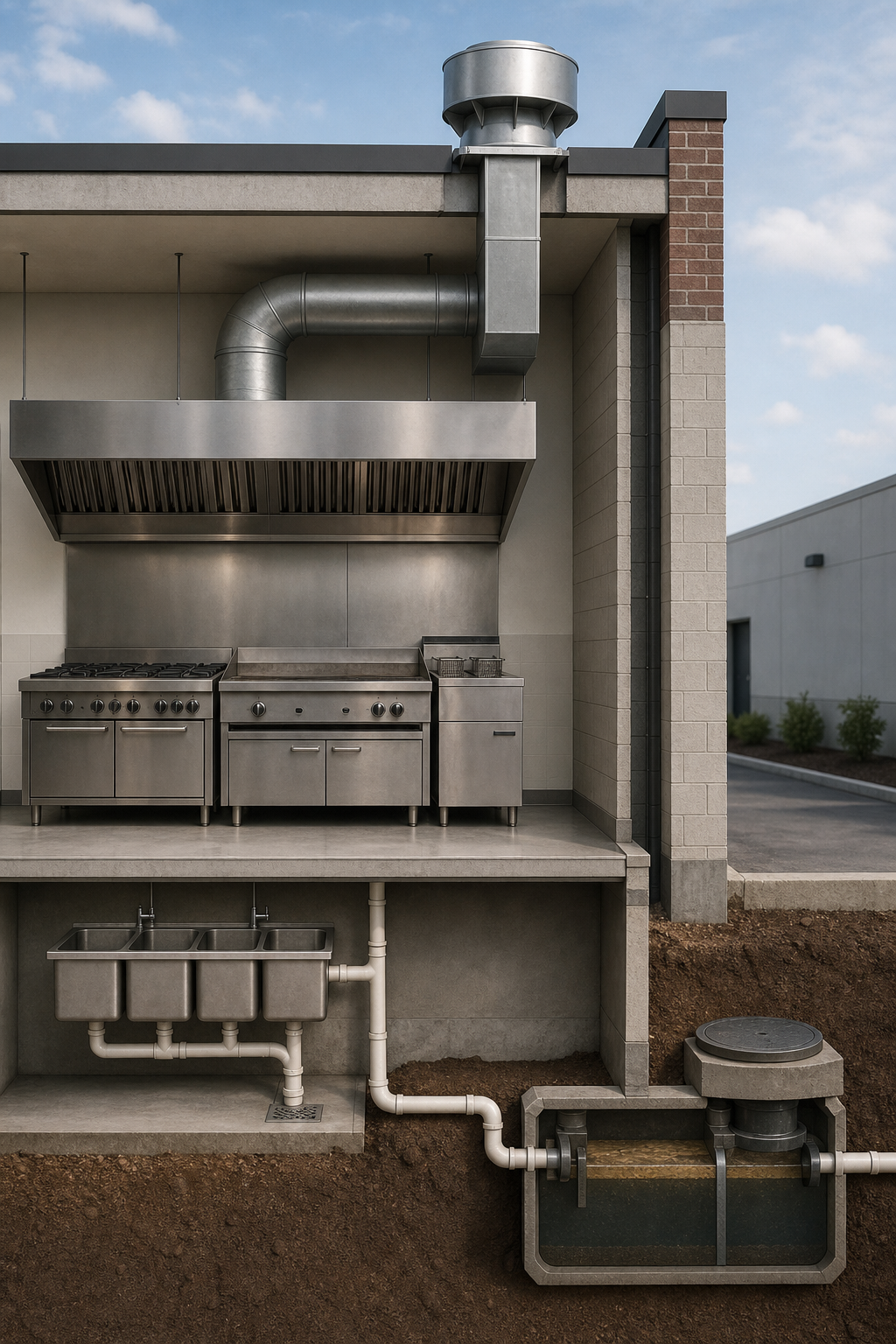
Look up: the hood and exhaust path
Start above the cooking line. The commercial exhaust path can include the canopy, grease-removal devices or filters, plenum, horizontal and vertical ducts, rooftop fan, and related components. Hood and exhaust cleaning concerns grease and residue on the agreed, accessible surfaces along that path.
Forney’s vent-a-hood code section names hoods, grease-removal devices, fans, horizontal and vertical ducts to the roof, and other appurtenances in its cleaning language. That does not mean every quote includes every component or that every area is accessible. Ask what is included, excluded, blocked, separately priced, photographed, and documented.
Use the kitchen exhaust cleaning page for the detailed hood-to-fan system map. If the concern is buildup at the canopy, filters, duct access, fan, or roof containment area, it belongs in the hood-cleaning conversation.
Look down: the drain and grease-trap path
A plumbing grease trap or interceptor receives wastewater from the fixtures connected to it. Its job, access, pumping process, transport requirements, and disposal record are separate from the overhead exhaust system.
Forney’s code generally places food-establishment grease traps outside unless written approval allows another location, and it requires access for cleaning. The exact installation and connected fixtures depend on the restaurant’s plumbing and approved plan, so do not infer them from the hood layout or open a trap to investigate.
If the concern is a trap or interceptor, wastewater flow, pumping date, tank access, trip ticket, or disposal record, it belongs in a grease-trap conversation. Texas Commission on Environmental Quality guidance says grease-trap waste transport requires a registered sludge transporter and that municipal liquid waste goes to an authorized facility.
Compare the scope before scheduling
| Decision point | Hood and exhaust cleaning | Grease-trap cleaning |
|---|---|---|
| Physical system | Canopy, filters or grease-removal devices, plenum, ducts, fan, and related exhaust areas. | Plumbing-side trap or interceptor, inlet and outlet path, tank access, and liquid-waste collection. |
| What reaches it | Grease-laden vapors and cooking residue moving upward from the cookline. | Fats, oils, grease, solids, and wastewater entering through connected plumbing fixtures. |
| Service action | Inspect and clean the agreed, accessible exhaust-path surfaces; record anything inaccessible or not cleaned. | Pump and remove the grease-trap waste, clean the tank under the applicable scope, and transport the waste through the required process. |
| Access planning | Kitchen shutdown, equipment protection, filters, duct panels, roof access, fan access, gates, alarms, and property rules. | Trap or interceptor location, service-lid access, parked vehicles, gates, hoses, and the path for the transport vehicle. |
| Record to request | Cleaning label and certificate, plus the report, photos, invoice, and access or exception notes that define the actual work. | Trip ticket or waste manifest identifying collection and completed disposal, plus the service invoice and any local record required. |
| Question to settle | Which exhaust components are included, accessible, cleaned, and documented? | Which trap is being pumped, who is the registered transporter, where will the waste go, and what completed record returns? |
The equipment names can sound similar. A hood may have grease-removal devices, collection cups, or rooftop containment, but those are not automatically the plumbing grease trap or interceptor. Ask for a component name and location instead of relying on “the grease thing.”
Keep Forney’s two rule paths separate
The City of Forney addresses the systems in separate sections of its Food Service Establishments code: grease traps in section 6.04.012 and vent-a-hood systems in section 6.04.013.
For food establishments covered by the grease-trap rule, the city code says grease-trap waste is pumped and removed and the tanks thoroughly cleaned no less than once every 90 days. The same section allows written deviations, additional or immediate pumping, and stated exemptions. The City’s current Food Establishment Renewal Letter repeats the 90-day language and grease-waste hauler requirement.
That is not permission to apply one interval to every establishment. Confirm the current requirement for the actual location and operation with the responsible city authority.
The vent-a-hood section uses cooking type or volume to distinguish cleaning intervals and allows additional cleaning where the regulatory officer considers it necessary. Use the hood-cleaning frequency page for that separate planning task. Do not carry the grease-trap calendar over to the exhaust system or vice versa.
Keep two service records
Forney’s vent-a-hood section calls for a label showing the cleaning date and servicing company, plus a certificate showing the cleaning date kept on the premises and copied to the regulatory authority. A useful restaurant file can also connect that label and certificate to the hood-cleaning report, photos, invoice, and any inaccessible-area notes. The hood-cleaning documentation page explains that record set.
Grease-trap pumping uses a different paper trail. TCEQ’s current sludge-transporter program includes grease-trap waste, and its municipal liquid-waste guidance says transported waste must use a registered sludge transporter. TCEQ’s transporter guide calls the collection-and-disposal record a trip ticket or waste manifest: the generator receives a pickup copy and a completed copy after the disposal facility accepts the waste.
Store the two record sets in the same restaurant maintenance system if that is convenient, but label them by system. A hood-cleaning label is not a grease-trap disposal record, and a grease-waste trip ticket is not proof that the exhaust path was cleaned.
Prepare the right conversation
For hood and exhaust cleaning, have these details ready:
- Restaurant address and the hood, filter-bank, and fan count.
- Last supported hood-cleaning date and the related label, report, photos, and invoice.
- Cooking type or volume, usual shutdown window, and the exact exhaust concern.
- Duct-panel, roof, fan, gate, alarm, and property-access notes.
- Any component that was previously inaccessible, excluded, or left for follow-up.
For grease-trap pumping, prepare a separate list:
- Trap or interceptor location and safe service access.
- Last supported pump-out date and available trip ticket or manifest.
- Tank capacity or system identifier from the approved records, when available.
- Registered transporter information and the planned authorized receiving facility.
- Any current City of Forney direction, written deviation, added-frequency instruction, or exemption that applies to the establishment.
Do not climb onto the roof, open duct access, remove protected components, or open a grease interceptor just to finish either list. Existing records, safe floor-level observations, and direct questions are enough to prepare the calls.
When both may be due
A manager may discover both overdue records during a restaurant takeover, inspection follow-up, missed maintenance cycle, or file cleanup. Coordinate access if it helps the restaurant, but keep the scopes and approvals separate:
- Name the exhaust system and grease trap or interceptor separately.
- Ask who is responsible for each job and record.
- Confirm whether the appointments, access plans, and invoices are separate or combined.
- Require each completed record to identify its own system and work.
- Route findings outside the agreed work to the appropriate cleaning, plumbing, waste, mechanical, fire-suppression, property, or city conversation.
For the overhead system, review the commercial hood-cleaning scope in Forney and call with the hood, fan, access, timing, and record details ready. Confirm the final work, price, credentials, timing, and availability directly. Grease-trap pumping remains a separate scope that should be arranged through the applicable City and TCEQ-compliant process.